
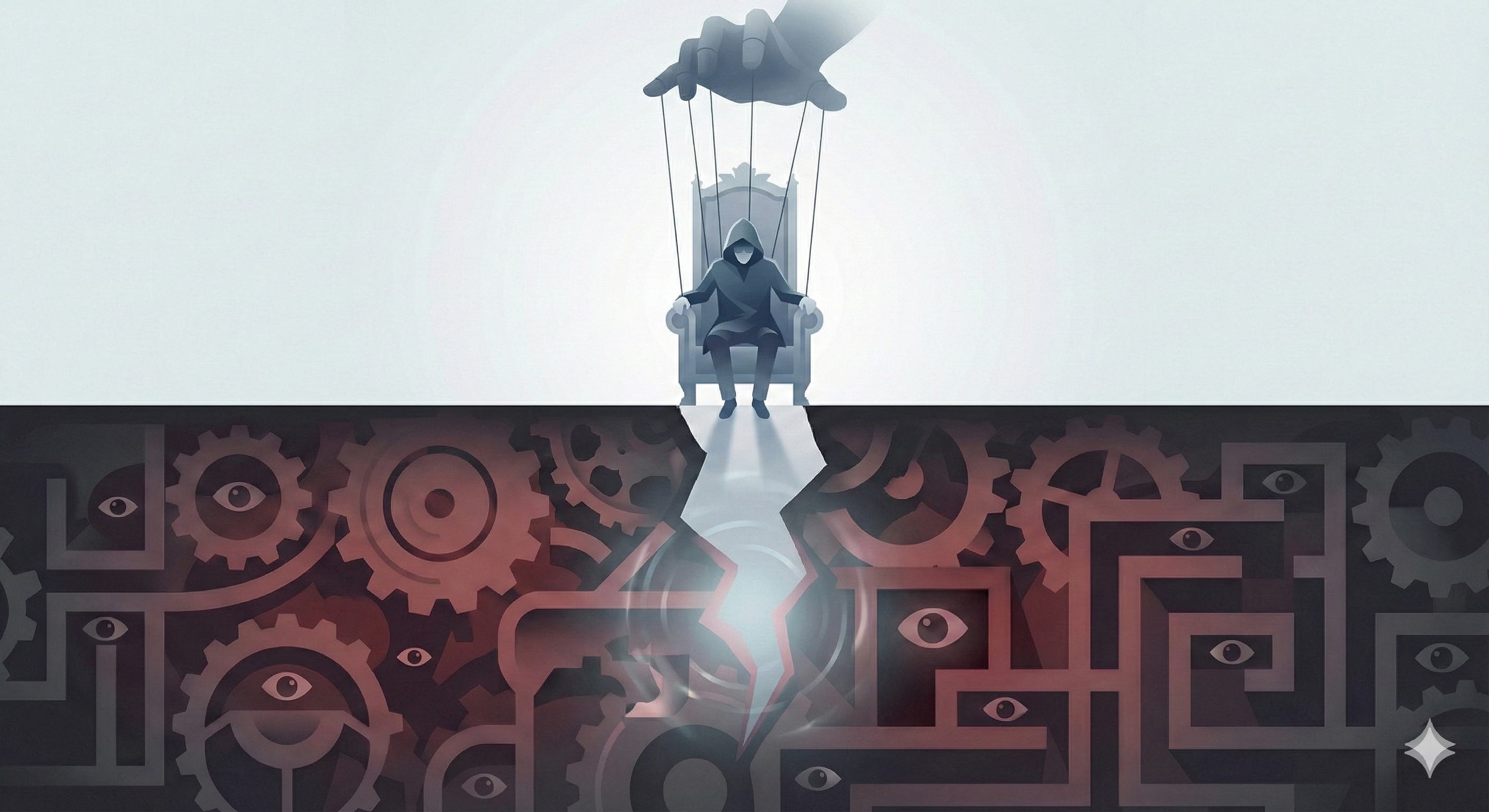
In Brief #7 of this series, I argued that the most powerful man in Iran is Ali Larijani — a figure who cannot become Supreme Leader because he is not a senior cleric. Today, The New York Times reported what this project has been tracking for weeks: Khamenei has effectively handed operational control of the country to Larijani, issuing four layers of succession directives for every position he personally appoints and delegating crisis authority to a small circle of loyalists.
This raises the question that Brief #7 left dangling: if the man actually running Iran cannot hold the only office that constitutionally matters, what happens when that office needs to be filled?
The answer requires understanding a story from 1989 — because the Islamic Republic has faced this exact problem before, and the solution it found last time created the system everyone is now trying to survive.
The Last Time They Picked a Puppet
When Ayatollah Ruhollah Khomeini died in June 1989, the Islamic Republic faced a succession crisis remarkably similar to the one emerging today. Khomeini’s designated successor, Grand Ayatollah Montazeri, had been stripped of the role five months earlier for criticizing the regime’s mass executions. The most powerful politician in the country was Akbar Hashemi Rafsanjani — speaker of parliament, de facto war commander, and the man most responsible for ending the devastating conflict with Iraq. Rafsanjani was, by every institutional measure, running Iran.
But Rafsanjani was not a senior enough cleric to become Supreme Leader. So he engineered the selection of someone who was: Ali Khamenei, then serving as president. Khamenei held only the rank of hojatolislam — mid-level in the Shia clerical hierarchy — and the existing constitution required the Supreme Leader to be a marja (grand ayatollah). Rafsanjani solved this by ramming through a constitutional amendment that removed the marja requirement, retroactively legalizing what was otherwise an unconstitutional appointment.
Leaked footage from the Assembly of Experts session captures the arrangement’s intended nature. Khamenei told the assembled clerics that his leadership would be “formal, only on paper, not a real one.” Rafsanjani believed he had installed a figurehead — a man who would hold the title while Rafsanjani held the power.
He spent the next three decades trying to wrestle that power back. He failed.
What happened? The office itself transformed its occupant. The constitution grants the Supreme Leader commander-in-chief authority over all armed forces, appointment power over the judiciary, state media, key military commanders, and the Guardian Council. These are not ceremonial powers. They are operational levers. Khamenei used them systematically, forging an alliance with the IRGC that gave him a power base independent of the man who had put him in office. Within a decade, the “puppet” had become the most powerful figure in the country, and his patron had been permanently outmaneuvered.
As Carnegie’s Karim Sadjadpour put it: Rafsanjani made Khamenei Supreme Leader thinking he would be weak and pliant. The “accident of history” transformed a weak president into an initially weak Supreme Leader into one of the five most powerful Iranians of the last century.
Why Everyone Wants a Puppet Again
The structural conditions of 2026 make a puppet Supreme Leader the most likely near-term succession outcome — not because anyone has forgotten the 1989 lesson, but because every major faction independently prefers a controllable figurehead to the alternatives.
Consider the incentives.
The IRGC controls 25-40% of GDP through its economic empire — construction conglomerates, banks, import-export networks, the sanctions-evasion infrastructure that keeps Iranian oil flowing to China. The Washington Institute has noted openly that the IRGC might prefer a weak, ailing ayatollah as Supreme Leader specifically to constitutionalize their own power. A strong leader could constrain them. A weak one legitimizes the status quo.
Larijani and the pragmatist network — now running the state apparatus through the SNSC — need the deal track to survive. A Supreme Leader who defers to Larijani’s diplomatic judgment preserves the negotiating channel. A Supreme Leader with independent views on the nuclear file could blow up Geneva the way Jalili blew up every negotiation from 2007 onward.
Ghalibaf, as parliament speaker, holds the constitutionally mandated wartime commander role and sits on the Provisional Leadership Council that would govern during any interregnum. His institutional position improves under a weak leader who depends on parliamentary cooperation.
Even the eschatological faction — Mirbagheri and the Paydari network documented in Brief #4 of this series — would prefer a controllable Supreme Leader to a strong one who might constrain their institutional capture. Mirbagheri himself sits on the Assembly of Experts. Whether he seeks the office or the role of kingmaker, a puppet arrangement serves both paths.
The convergence is striking. In a system riven by factional warfare so intense that the Stimson Center describes it as “raw, unchecked partisan warfare” following Khamenei’s withdrawal from active governance, a puppet is the one outcome that requires the least factional agreement. Nobody has to win. Everyone just has to agree on someone weak enough that they all believe they can control him.
The Candidate Who Fits the Pattern
Which brings us to Hassan Khomeini.
The grandson of the Islamic Republic’s founder has emerged as a serious succession contender in the past eight months, and the acceleration of his positioning in February 2026 has been remarkable. On February 9, Khamenei sent Hassan Khomeini as his personal representative to the Revolution Day ceremony — a near-sacred event in the Islamic Republic’s calendar. Foreign Policy reported on February 19 that Hassan Khomeini appears “relatively strengthened” in the post-massacre power reconfiguration, alongside Larijani and Shamkhani. Reuters had identified him as one of two frontrunners alongside Mojtaba Khamenei during the June 2025 war.
But the structural parallel to 1989 is what matters analytically, not the name.
Hassan Khomeini holds the rank of hojatolislam — the same mid-level clerical rank Khamenei held in 1989. He has no governance experience; Khamenei at least had eight years as president. He was barred from running for the Assembly of Experts in 2016, a signal that the system’s gatekeepers did not consider him ready for the top tier. His political identity is associated with the reformist movement — but the reform camp’s organizational infrastructure has been systematically destroyed in the largest purge since 2009, with senior former officials and Reform Front leaders arrested in the wake of the January protests.
This creates what I call the “brand without a product” paradox. Hassan Khomeini carries the reformist label and the Khomeini lineage — an extraordinary combination of democratic legitimacy and revolutionary legitimacy — but the actual movement he is associated with is being dismantled around him. He would arrive at the Supreme Leader’s office with a powerful brand and no organizational base. That is, from every other faction’s perspective, the ideal combination.
The behavioral repositioning has been visible. During and after the January massacres, Hassan Khomeini aligned with the crackdown. His public rhetoric shifted toward regime-affirming language. RAND noted in January that “Pezeshkian, Hassan Khomeini, and Iranian reformists are still ultimately pro-regime figures.” He is performing the same loyalty audition that Khamenei performed for Khomeini’s inner circle before 1989 — demonstrating that he can be trusted not to rock the boat.
A London-based analyst told Reuters the quiet part out loud: the regime must opt for someone who will “facilitate slow transition.” That framing tells you what the choosing faction believes they are choosing: not a leader, but a vehicle.
The Office Has a Memory
Here is the problem with the puppet strategy, and it is the central analytical finding of this brief: the office of Supreme Leader generates its own gravitational field.
The 1989 precedent is not just a historical anecdote. It is an empirical data point about the structural properties of the position itself. The Iranian constitution concentrates more unilateral power in the Supreme Leader than in almost any other single office in any government worldwide. Commander-in-chief authority. Appointment of the judiciary head. Control of state media. Final authority over foreign and security policy. Veto power over every electoral candidate through the Guardian Council. Life tenure with no term limits.
These powers do not switch off because the occupant was selected for weakness. They are constitutional facts that create institutional incentives — and the most important incentive they create is the opportunity for alliance. Khamenei transformed himself from Rafsanjani’s puppet into the country’s unquestioned leader by allying with the IRGC. Needing a power base of his own, he became their champion, and they became his praetorian guard. The alliance was structurally inevitable: a weak leader needs a strong ally, and the IRGC needed a patron who would protect their expanding economic empire from civilian oversight.
As the War on the Rocks analysis noted in January: “The office itself no longer clearly commands the authority needed to reproduce itself.” But this gets the causality backwards. The office doesn’t need to command authority at the moment of succession. It needs only to confer authority — which it does constitutionally, automatically, upon investiture. What happens next is a function of the new occupant’s ability to leverage those constitutional powers against the factions that put him there.
A Hassan Khomeini — or any puppet candidate — who reaches the Supreme Leader’s office inherits every lever Khamenei used to escape his own puppet status. The Khomeini name actually amplifies this: it carries weight in the religious establishment and among the population in a way that Khamenei’s name never did at the start. A Khomeini-branded Supreme Leader with access to the office’s constitutional powers and a motivation to prove he is more than a figurehead is a structural time bomb for the factions that installed him.
This does not mean the puppet will necessarily consolidate power. The 1989-to-2026 trajectory required Khamenei to survive multiple crises, cultivate the IRGC alliance over decades, and outlast every rival including Rafsanjani himself. The conditions may not repeat exactly. But the structural incentive is identical: a leader selected for weakness has every institutional reason to seek strength, and the office provides the tools.
What This Means for the Deal
The succession has three plausible configurations, and the nuclear deal’s survival probability is different under each.
Configuration A — a strong, independent Supreme Leader — would mean someone like Mirbagheri, who arrives with his own ideological base, theological authority, and institutional network. Under this configuration, the deal is dead on arrival. The eschatological faction’s entire theology defines diplomacy with the West as surrender. This is the scenario Brief #4 warned about.
Configuration B — a weak Supreme Leader managed by the apparatus — is the puppet scenario, and the most likely near-term outcome. Under this configuration, the deal’s survival depends on which faction controls the puppet. If Larijani’s pragmatist network maintains its grip, the deal has a window. If the IRGC economic establishment dominates, the deal becomes a vehicle for sanctions relief without structural reform — the hollow deal thesis from Brief #7. If Mirbagheri’s network captures the kingmaker role, Configuration B degrades into Configuration A over time.
Configuration C — de facto collective leadership — is arguably what already exists. Larijani runs the SNSC, Ghalibaf commands wartime military authority, the IRGC controls the economy, and the Supreme Leader’s office provides constitutional cover. Under this configuration, the deal survives only as long as the collective holds — and collectives in authoritarian systems are notoriously unstable. They are holding patterns, not equilibria. The Soviet Politburo after Stalin, the Chinese leadership after Mao, and the Yugoslav collective presidency after Tito all demonstrate the pattern: shared power works until one participant accumulates enough advantage to break the arrangement.
This is where the puppet problem intersects with the findings from earlier in this series. Brief #5 documented the “compliance paradox” — the more the regime concedes in a deal, the weaker it becomes internally. Brief #7 showed that the man running Iran publicly dismissed his own diplomatic track as “inverted courage.” The puppet problem adds a temporal dimension to both: even if the current power configuration can negotiate and sign a deal, the configuration itself is a transitional state that will not persist through the deal’s implementation period.
The policy-critical finding is this: Configuration B is the most likely near-term outcome, and it is structurally unstable. The puppet arrangement is attractive at the moment of succession precisely because it avoids factional confrontation. But it contains a built-in expiration date — the same expiration date that turned Rafsanjani’s 1989 puppet into the man who outmaneuvered him for thirty years.
For deal planners, the timeline implication is devastating. Any nuclear agreement signed with Iran in 2026 has an implementation horizon measured in years. Khamenei is 86. The Succession Clock documented in this project’s earlier analysis is already running. A deal signed today is almost certainly a deal that must survive a succession — and a succession that produces a puppet creates a leadership configuration that will itself transform within 3-7 years as the new leader consolidates or is replaced.
This means the deal’s counterpart is not the person who signs it. It is not even the person who succeeds the person who signs it. It is the power configuration that emerges after the puppet either escapes his handlers or is consumed by them. Any deal design that does not model this trajectory is planning for a country that will not exist in its current form.
The Authorization Chain Terminates
In intelligence analysis, an “authorization chain” traces who actually has the authority to approve and sustain a commitment. The current chain for any Iranian international agreement runs through Khamenei, who authorizes the SNSC to negotiate, which empowers Araghchi to execute at the table.
At succession, this chain terminates. A new Supreme Leader — especially a puppet — must reconstruct his own authorization chain. The pragmatist negotiators who signed the deal may no longer have the backing to enforce compliance. The IRGC commanders who tacitly accepted the deal may recalculate under new leadership. The institutional resisters documented throughout this project gain a reset opportunity to renegotiate their accommodation.
The 1989 precedent is instructive here too. When Khamenei replaced Khomeini, the entire power structure realigned over the subsequent years. Rafsanjani went from puppet-master to marginalized rival. The IRGC went from revolutionary militia to economic empire. The presidency went from the most powerful elected office to a ceremonial position subordinate to the Leader’s appointees. Every institutional relationship was renegotiated.
A deal that assumes continuity through succession is not a deal. It is a hope.
This is Brief #8 in the Iran Transition Project series. Previous briefs: #1 “The Doctrine They Don’t Want You to Know About” (taqiyyah), #2 “The Country Inside the Country” (IRGC parallel society), #3 “Iran Is Not Iraq,” #4 “The Spoiler” (eschatological faction), #5 “The Deal That Cannot Hold” (Pinochet pivot), #6 “The Day After,” #7 “Who Is Actually Running Iran?”
The Iran Transition Project provides independent structural analysis of Iran’s regime architecture and transition dynamics. The author maintains no factional allegiance and does not advocate for any specific succession outcome. This brief is analytical description, not policy advocacy.
Sources include: The New York Times (Fassihi, Feb 22, 2026), Foreign Policy (Feb 19, 2026), Reuters/Times of Israel (June 2025), Newsweek (June 2025), Middle East Eye (Feb 22, 2026), Israel Hayom (Feb 22, 2026), Haaretz (Feb 22, 2026), Carnegie Endowment (Sadjadpour), Washington Institute, War on the Rocks (Jan 2026), RAND (Jan 2026), Middle East Forum (Feb 2026), Stimson Center (Nov 2025), UANI succession analysis series, Amwaj Media, Iran International (Nov 2024), PBS NewsHour, Middle East Institute, ScienceDirect/Orbis (Sherrill), Jamestown Foundation.
Man, this trip down memory lane to 1989 is exactly the context we’re missing in 2026. The irony of history repeating itself—where a 'weak' figurehead like Khamenei eventually outmaneuvered his patron—is a haunting warning for Larijani and the IRGC today. We’re seeing the exact same 'Puppet Strategy' being deployed, but as you’ve highlighted, the constitutional levers of the Supreme Leader office have a way of transforming the occupant. The 'Accident of History' is about to happen all over again. Exceptional analysis!